
Last Updated: November 22, 2026
Quick Summary
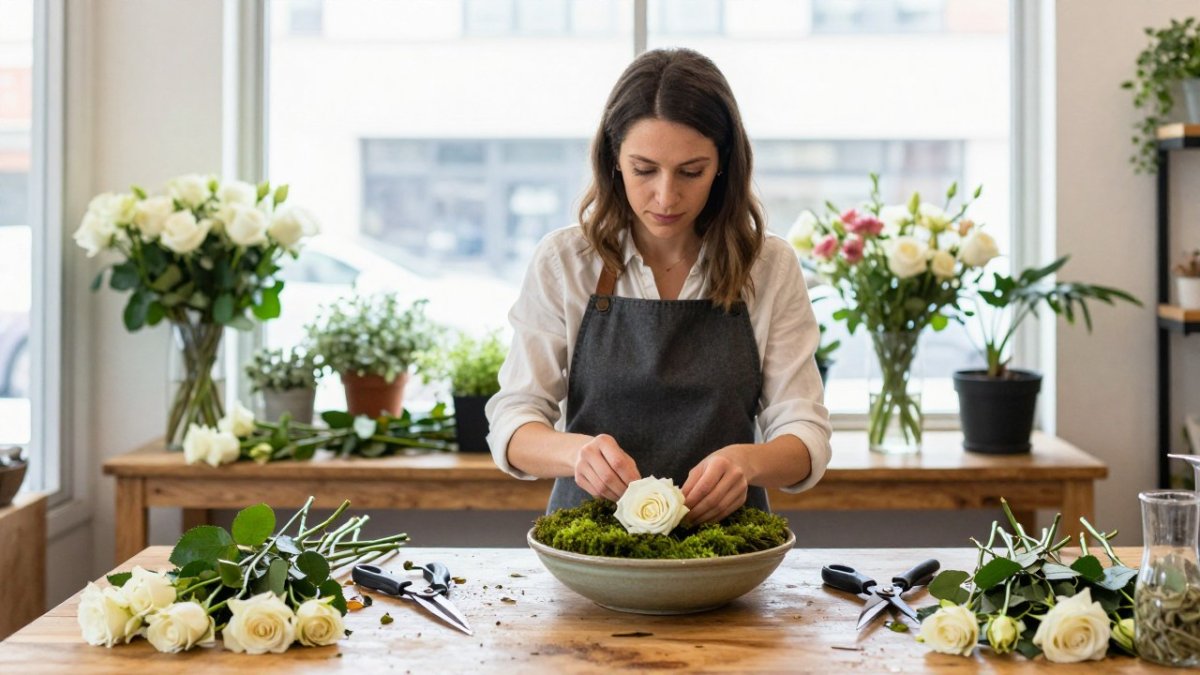
To arrange flowers in a low centerpiece, start with a shallow bowl 8 to 12 inches wide and set your mechanics, then build a greenery base layer before adding focal flowers in odd numbers and filling gaps with smaller blooms. Keep the total height under about 10 inches so sightlines stay clear across the table.
- Cut stems to roughly one and a half times the bowl’s depth, so a 4-inch bowl takes 6-inch stems.
- Soak floral foam fully, trim it half an inch below the rim, and tape it down.
- Place focal flowers in odd numbers like three or five, set at different heights and angles.
- An 8-inch bowl takes about 14 stems total: 3 to 5 focal, 5 to 7 filler, 4 to 6 greenery.
- Empty and refill the bowl every two days and recut each stem at a fresh angle.
Table of Contents
- What You Need Before You Start a Low Centerpiece
- Step 1: Prep the Container and Set Your Floral Mechanics
- Step 2: Build the Greenery Base Layer
- Step 3: Place Focal Flowers and Fill the Gaps
- How to Arrange Flowers Without Floral Foam
- How to Make a Centerpiece With Fake Flowers
- Sizing, Stem Counts, and Low Floral Centerpieces for Weddings
- Ordering Custom Low Centerpieces for Your Event
- Frequently Asked Questions
What You Need Before You Start a Low Centerpiece
A low centerpiece is a floral arrangement built in a shallow container so it stays under about 10 inches tall, keeping sightlines clear across a table. Learning how to arrange flowers in a low centerpiece starts with the right tools, not the right blooms. The setup always decides how the design turns out.
Gather these supplies first:
- A shallow bowl or low vase, 8 to 12 inches wide
- Floral foam, wire netting, or a pin holder
- Sharp floral scissors or a knife
- Greenery for the base layer
- Focal flowers and smaller filler blooms
- A water pitcher and a towel
Skip the prep and the whole design suffers. The USDA’s cut flower care guidance makes one point clear: clean tools and clean water keep stems alive longer. That matters twice as much in a shallow bowl, where stems sit close to the surface.
Choosing Low Vases for Centerpieces
Low vases for centerpieces need one thing above all: a wide mouth. A bowl with a narrow opening forces every stem into a tight bunch, and the arrangement looks like a bouquet lying down. Look for a dish at least 8 inches across and 3 to 5 inches deep.
Stem length matters here too. Cut stems to roughly one and a half times the bowl’s depth. A 4-inch bowl takes stems about 6 inches long. That ratio keeps the flowers sitting just above the rim instead of towering over the table.
Step 1: Prep the Container and Set Your Floral Mechanics
Floral mechanics are the hidden support system that holds stems where you put them. In a low bowl, you have three good options, and each suits a different look.
| Mechanic | Best For | Watch Out For |
|---|---|---|
| Floral foam | Dense, structured designs | Foam crumbles and is not reusable |
| Wire netting | Loose, natural designs | Needs anchoring with tape or a pin |
| Pin holder | Heavy stems, open designs | Limited placement spots |
Soak foam fully before cutting it. Push it down; never let it float. Trim the block so it sits about half an inch below the rim, then tape it down with floral tape across the bowl. For netting, crumple it into a loose ball and secure the edges with waterproof tape.
Fill the bowl with water after the mechanics are set. Watch out: dry foam wicks water away from stems fast, so top it off every day.
Step 2: Build the Greenery Base Layer
Greenery comes first, always. The base layer sets the shape, hides the mechanics, and gives every flower a soft place to sit. Skip it and gaps show bare foam.
Start with the largest leaves. Place them around the rim, letting them drape slightly over the edge. Then work inward with smaller foliage. Keep the height low, no more than 4 to 5 inches above the bowl.
Good greenery choices include:
- Seeded eucalyptus for soft, trailing edges
- Leatherleaf fern for quick coverage
- Ruscus for strong, upright lines
- Pittosporum for a rounded, full look
Step back after the greenery. The base should already look finished, like a small green garden. If it does not, add more before any flower goes in.
Step 3: Place Focal Flowers and Fill the Gaps
Focal flowers are the large, showy blooms that draw the eye. Place them third, after the greenery, and place them in odd numbers. Three or five roses read better than four.
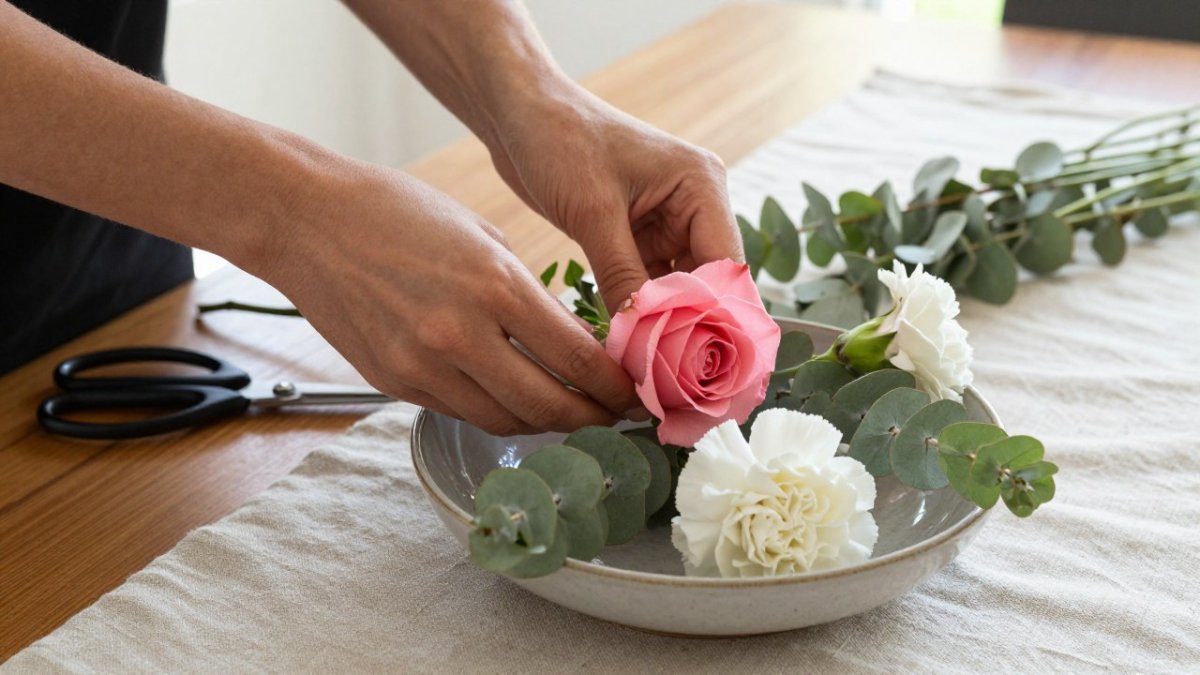
Set each focal flower at a slightly different height and angle. A common mistake is lining them up like soldiers. Instead, group them in loose clusters of two or three.
Then fill the gaps with smaller blooms. Airy flowers like spray roses, waxflower, or statice soften the edges. Colored stems add contrast. For bloom-by-bloom ideas, our guide to the best flowers for wedding centerpieces covers which varieties hold up best in shallow bowls.
How to Arrange Flowers Without Floral Foam
You can arrange flowers without floral foam using wire netting, a pin holder, or a simple crisscross of stems. Foam-free designs are easier to reuse, kinder to the garden, and let you change the water without wrecking the design, which foam never allows.
Here is the method we use:
- Crumple chicken wire into a loose ball roughly the size of the bowl’s opening and tape it down with waterproof floral tape across the rim.
- Fill the bowl with water to within an inch of the rim.
- Build greenery through the wire mesh first, working from the rim inward.
- Add focal flowers through the gaps in the netting, angling each stem so it rests against the wire.
- Finish with airy fillers, then top off the water.
The wire holds stems at any angle, so the design stays loose and natural.
Each method has a trade-off. Wire netting is the most forgiving and the easiest to reuse, but it can show through a sparse design, so keep the greenery layer full.
Watch out: wire netting that is not anchored will lift out of the bowl when you pull a stem, taking half the arrangement with it. Tape the edges down in at least four places before you add a single flower.
Foam-free designs also make water changes easy, and that is where longevity comes from. Empty and refill the bowl every two days, recut each stem at a fresh angle, and keep the arrangement out of direct sun and away from heating vents.
How to Make a Centerpiece With Fake Flowers
To make a centerpiece with fake flowers, use dry foam or a glue-free wire base instead of water. Silk and dried stems need no water, so the mechanics change completely.
Push stems into dry foam set in the bowl, or bend them through wire netting for a looser look. Bend each stem to the height you want before placing it; fake stems hold their shape. Mix textures, since faux blooms can look flat alone. Add dried eucalyptus or preserved greenery for depth.
Keep fake arrangements out of direct sun. Colors fade fast near a bright window, and dust settles into fabric petals. A quick blast with a hair dryer on cool keeps them fresh.
Sizing, Stem Counts, and Low Floral Centerpieces for Weddings
Low floral centerpieces for weddings follow one rule above all: keep the total height under 10 inches so guests can see across the table. That number is not arbitrary. A standard dining table sits about 30 inches high, and a seated adult’s eye line falls roughly 44 to 48 inches from the floor. An arrangement that tops out at 10 inches above the table leaves a clear band of sight between guests. Push past 12 inches and people start leaning sideways to talk.
Width is the other half of the equation. On a round table, a centerpiece can run 12 to 18 inches across without crowding place settings. Leave at least 12 inches between the edge of the arrangement and each place setting so guests have room for a plate, a glass, and their elbows.
Stem counts are where most people guess wrong. A workable plan by container size:
- 8-inch bowl: 3 to 5 focal blooms, 5 to 7 filler stems, 4 to 6 greenery stems (about 14 stems total)
- 10-inch bowl: 5 to 7 focal blooms, 8 to 10 filler stems, 6 to 8 greenery stems (about 20 stems total)
- 12-inch bowl or low trough: 7 to 9 focal blooms, 10 to 14 filler stems, 8 to 12 greenery stems (about 30 stems total)
Treat those as starting points, not laws. A bowl packed with dense blooms like roses or peonies needs fewer stems than one filled with airy flowers like waxflower or statice. Buy about 10 percent extra greenery; it is the layer you will add to most often when a gap shows.
For a table of eight, plan one 10- to 12-inch centerpiece plus two small accent arrangements, or three 8-inch bowls spaced evenly down the table. If you are working to a set budget, our guide to affordable wedding flower packages shows how packages spread cost across tables. For broader table decor ideas, see our complete guide to floral decor for events.
Watch out: a centerpiece that looks right on the workbench can block sightlines once it sits on a clothed table. Set the finished arrangement on a table-height surface and sit down across from it before you commit to the design.
Stem counts by bowl size for low centerpieces
Ordering Custom Low Centerpieces for Your Event
Not everyone wants to build these by hand, and that is fine. We design custom low centerpieces for weddings, corporate dinners, and celebrations, with on-site decorating included for events. You pick the palette and the container style; we handle the mechanics, stem counts, and delivery.
Two ready-made options show the look: our Fall Fields Centerpiece and the Fields for Fall Centerpiece. Both sit low and wide, exactly where a centerpiece belongs.
Pricing depends on quantity, dates, and delivery, so reach out for a current quote. Tell us your table count and color palette, and we will map out the stem plan with you.
Building a low centerpiece that looks effortless takes practice, and the mechanics matter more than the flowers. If you would rather hand the work to a designer, An English Garden brings over 30 years of local experience, an award-winning designer on staff, and full event consultation with on-site decorating. We deliver fresh arrangements daily across the region, and we will match your palette, table count, and budget.
Frequently Asked Questions
How tall should a low centerpiece be?
Keep the finished height under about 12 inches so seated guests can see across the table. A common target is 8 to 10 inches tall and 18 to 24 inches wide, which keeps the low centerpiece visually balanced without blocking conversation. Measure your container first, then plan stem length so flowers sit just above the rim rather than towering over it. If your table is narrow, reduce the width to roughly 12 to 16 inches so plates and glassware still fit.
How do you keep flowers in place in a shallow bowl?
Use floral mechanics instead of relying on the vase walls. Tape a grid of wire netting or waterproof tape across the opening, or nestle a small piece of soaked floral foam into the bowl. For a foam-free approach, crumple chicken wire or use a pin holder (kenzan) at the base. Each stem should pass through the grid or grip the wire so it holds its angle. Trim stems at a 45-degree angle and push them in firmly, then adjust spacing so the arrangement stays balanced.
How do you make a low centerpiece look full?
Build in layers rather than stuffing in more flowers. Start with a dense greenery base of foliage that spills slightly over the rim, then add large focal flowers in odd-numbered clusters of three or five, and finish with smaller airy blooms tucked into gaps. Grouping flowers in clusters instead of dotting them evenly creates volume with fewer stems. A 12-inch bowl typically needs about 15 to 20 stems total, including greenery, to read as full.
How do you arrange flowers without floral foam?
Foam-free mechanics rely on structure: wire netting, a tape grid, pin holders, or bundled stems. For a low arrangement, tape a grid over the container opening, add crumpled chicken wire for grip, then arrange greenery first to create a nest. Stems hold each other in place as the arrangement fills in. This method also keeps water cleaner and lets you refresh the display. Change the water every two days and re-trim stems to extend the life of the centerpiece.
