
Quick Summary
Quality floral design is an arrangement built on fresh material, sound structure, balanced composition, and a color scheme that suits its setting. You can check it in a few minutes by inspecting freshness, design elements, color, mechanics, and scale.
- Check stems for firmness, petals for clean color, and water for clarity on arrival.
- Judge composition using line, form, space, texture, and color, plus principles like balance and proportion.
- Tilt, lift, and shake the arrangement to test whether its mechanics are stable enough for transport.
- Use a 1 to 5 score in four categories to compare arrangements on a consistent basis.
Table of Contents
- How to Identify Quality Floral Design
- Why Quality Floral Design Is Worth Learning to Spot
- Step 1: Check the Freshness and Condition of the Flowers
- Step 2: Review the Elements of Floral Design
- Step 3: Judge the Principles of Floral Design
- Step 4: Test the Color Choices Against Flower Color Theory
- Step 5: Inspect Construction, Mechanics and Durability
- Step 6: Score the Arrangement for Scale and the Display Setting
- Spotting Common Defects and Troubleshooting Problems
- Frequently Asked Questions
How to Identify Quality Floral Design
Last Updated: October 29, 2026
Why Quality Floral Design Is Worth Learning to Spot
Quality floral design is the difference between an arrangement that looks fresh for a week and one that wilts by the weekend.
Quality floral design is an arrangement built on fresh material, sound structure, balanced composition, and a color scheme that suits its setting.
This guide gives you a simple, repeatable way to check all of it, with six steps plus common defects and fixes.
Step 1: Check the Freshness and Condition of the Flowers
Start with the flowers themselves. Fresh material is the foundation of any good arrangement, and no amount of skilled design can rescue wilted stems.
A quick check on arrival takes about two minutes. Look at each bloom in good light and touch the stems gently.
- Blooms should look firm and fully hydrated, not limp or papery, and local flowers last longer for reasons worth understanding.
- Stems should feel firm, with no slimy or mushy spots
- Water in the vase should look clear, not cloudy or smelling sour, and you can find practical care steps to keep blooms alive longer on this page.
Petal, Stem and Foliage Checks
Each part tells you something different: petals show age and handling, stems show hydration and cut quality, and foliage shows how well the material was cared for.
- Petals: Look for tears, bruising, or browning at the edges. Clean, even color is a strong sign of freshness.
- Stems: Check that cuts look clean and angled. Stems that are crushed or split will drink poorly.
- Foliage: Healthy leaves hold their color and shape. Spots, curling, or yellowing suggest the material was stressed.
A common mistake is judging only the showiest flowers; check the less prominent stems too, since weak material often hides in the back.
Step 2: Review the Elements of Floral Design
Once you know the material is fresh, look at how it is put together.
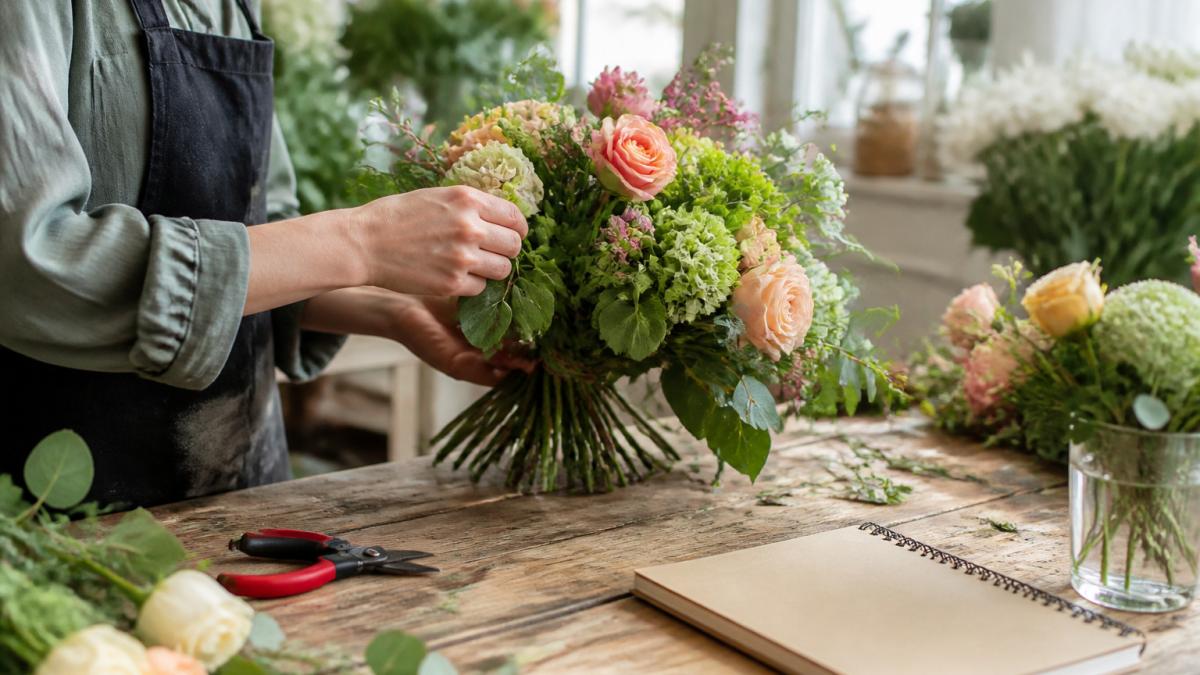
Form is the overall shape, a clear dome, cascade, or triangle reads easily from across a room.
Space is the air between stems and blooms; used on purpose, it keeps an arrangement from looking crowded.
Texture adds visual interest. Smooth petals, rough foliage, and glossy leaves work together when chosen with care.
Look for these signs in the arrangement you are reviewing:
- Each element supports a clear overall shape
- The lines lead your eye to a focal point
- Spacing feels deliberate, not random
Step 3: Judge the Principles of Floral Design
The principles of floral design explain how the elements work together.
Balance means the arrangement feels stable, symmetrical or not; a lopsided piece that looks ready to tip over usually signals weak structure.
Proportion compares the size of each part to the others, so blooms relate well to the container and surrounding foliage.
Rhythm is the repetition or flow that moves the eye along, while harmony and unity mean every flower and accent belongs to the same design.
Use these questions as a quick check:
- Does the arrangement feel balanced from every side?
- Do the blooms and container look like they belong together?
- Does the design flow, or does it feel like separate pieces?
Step 4: Test the Color Choices Against Flower Color Theory
Color is one of the most noticeable parts of any arrangement, and it is also one of the easiest to get wrong.
Here is a simple way to test a palette:
- Identify the main colors in the arrangement.
- Check whether they sit next to each other, across from each other, or both.
- Decide whether the mix suits the setting, such as a soft pastel room or a bold event space.
A well-chosen palette usually has one dominant color, one or two supporting colors, and a small accent. Too many competing colors often make an arrangement look unfocused.
Color also depends on lighting: a palette that looks rich in a bright studio can look flat under warm indoor lights, so check it where it will be displayed.
Step 5: Inspect Construction, Mechanics and Durability
Beautiful flowers can still fail if the arrangement is poorly built. Construction and mechanics are the hidden parts of quality. They decide whether the design holds its shape, stays upright, and lasts through transport and display. Most top-ranking guides stop at composition and color; this is where you separate a professionally built piece from one that only photographs well.
Check the Base and Stem Support
Start at the bottom. A stable base should hold the arrangement upright without tipping, even when the table is bumped. Look for one of three common support systems, each with trade-offs:
- Floral foam (wet foam): Holds stems at fixed angles and is common for centerpieces and sympathy work. It must be fully soaked, dry foam repels water and starves stems. Foam is single-use and breaks down over time, so it suits short-display events better than long-lasting gifts.
- Grid or tape grid: A grid of tape or a lattice of stems across the vase mouth holds stems upright and lets you change water easily. It is the most durable option for vase arrangements and is easy to refresh.
- Chicken wire or pin holders (kenzan): Wire mesh or a metal pin holder grips stems mechanically without foam. These are reusable and give strong control for dense, low designs.
Whatever the system, stems should be secured, not just wedged in place. Gently press a stem near the rim; if the whole arrangement shifts, the support is too loose.
Test Stability and Transport Readiness
A well-built arrangement survives handling. Try these checks:
- The tilt test: Gently tilt the container about 15 degrees and return it upright. Stems should stay in place. If blooms drop or rotate, the mechanics are weak.
- The lift test: Lift the container a few inches and set it down. Water should not slosh over the rim, and the design should not lean.
- The shake test: A light side-to-side movement should not dislodge stems or send water flying.
Ask how the piece is packed for transport, since a florist who plans for the trip is usually planning for quality.
Judge Hydration and Expected Vase Life
Durability is mostly about water. Check these signals:
- Water clarity: Clear water is a good sign; cloudy or sour-smelling water means bacteria are building up and stems are likely to decline early.
- Cut quality: Cuts should be clean and angled, made with a sharp tool. Crushed or split stems drink poorly and wilt faster.
- Stem firmness: Firm stems signal good hydration. Mushy or slimy spots near the water line are a red flag.
Vase life depends on the flower types and the room’s temperature, so ask the florist what to expect from a given arrangement. Ask the florist which flowers in the piece are short-lived and which are long-lasting, and whether they recommend changing the water and recutting stems every couple of days.
Before you buy, ask two questions: “What support holds the stems?” and “How should I care for this to get the most days out of it?” A confident, specific answer is a strong quality signal.
Look for Clean, Hidden Mechanics
Good mechanics are invisible. Tape, wire, foam, and pin holders should be concealed, not poking through blooms. Visible mechanics usually mean the design was rushed or the designer ran out of material to cover the structure. A clean finish on the back and sides matters too, since arrangements are often seen from more than one angle.
Step 6: Score the Arrangement for Scale and the Display Setting
Scale is the last big test. An arrangement can be well designed and still look wrong if it is too big or too small for where it will sit. This is also where you can apply a repeatable scoring method, so your judgment stays consistent from one arrangement to the next.
Measure Scale Against the Vessel and the Space
Start with numbers rather than impressions. A few rules of thumb help:
- Vessel ratio: As a common guideline, the finished arrangement should stand roughly one and a half to two times the height of the container, with width in proportion to the vessel’s mouth. A tiny vase with a towering spray looks top-heavy; a wide bowl with a few short stems looks lost.
- Table clearance: For a seated dinner, keep the centerpiece around 12 to 14 inches or lower, or tall enough to sit clearly above eye level. Mid-height pieces are the usual culprit when conversation feels blocked.
- Viewing distance: A piece viewed from across a room needs larger blooms, bolder color blocks, and simpler lines; one viewed up close can carry finer detail and smaller flowers. Judge it from where people will actually stand.
Match the Setting and Occasion
A quiet reception area calls for restraint; a large event hall can handle more volume and drama. Check that the palette and style suit the room’s lighting and decor. A soft pastel palette can look washed out under warm, dim indoor light, while a bold palette can overwhelm a small, neutral room. Ask whether the arrangement was designed for the specific space or pulled from a standard recipe.
Apply a Repeatable Quality Rubric
Use the same four categories every time and rate each from 1 to 5 to turn a subjective impression into a comparable score.
| Category | What to Check | Score (1-5) |
|---|---|---|
| Freshness | Firm stems, clean petals, clear water, healthy foliage | |
| Composition | Clear form, balance, focal point, deliberate negative space | |
| Craftsmanship | Hidden mechanics, stable base, clean cuts, transport-ready | |
| Suitability | Fits vessel, space, viewing distance, and occasion |
How to read the total (out of 20):
- 17-20: Strong, professional-quality arrangement.
- 13-16: Solid, with one area worth improving.
- 9-12: Noticeable weaknesses; ask the florist about fixes.
Score the arrangement before it leaves the shop or on delivery, and note the weakest category. That single note tells you what to ask about, and gives you a fair basis for comparison across florists.
An arrangement that scores 4 or 5 in every category is usually a strong choice; scores of 2 or lower point to a problem worth fixing before display.
Spotting Common Defects and Troubleshooting Problems
Even good arrangements can show problems. Knowing the most common defects helps you catch them early and decide whether they can be fixed.
Wilting blooms are the most frequent issue, usually from poor hydration or heat exposure.
Crowded designs look heavy and hide the focal point; removing a few stems often improves the whole piece.
- Wilting: Recut stems under water and refresh the vase
- Crowding: Remove extra stems to restore negative space
- Tipping: Check the base and add support if possible
When you find a defect, ask the florist how they plan to address it.
Frequently Asked Questions
What makes a floral arrangement high quality?
A high-quality floral arrangement has fresh, undamaged flowers, a clear focal point, balanced visual weight, harmonious colors, and sound construction that holds its shape. Check that stems are cut cleanly and foliage is not wilted or bruised. Step back and confirm the design reads well from the viewing distance it will be displayed at. Sturdy mechanics, such as a secure base and properly anchored stems, indicate that the designer planned for the arrangement to last through transport and display.
How can you tell if flowers in an arrangement are fresh?
Look for firm petals without browning or bruising along the edges, upright stems with no slime or soft spots, and foliage that is crisp and evenly colored. Gently check whether blooms are opening well rather than already dropping pollen or petals. Flowers that droop soon after arranging, or that show brown stem ends, are signs of poor conditioning or age. Ask the florist when the flowers were delivered and how they were stored before design.
What are signs of poor floral design?
Common signs include a crowded or lopsided shape, no clear focal point, colors that clash without purpose, and filler flowers that overwhelm the main blooms. Visible wire, tape, or foam, gaps where the base shows, and stems that cross awkwardly are also warning signs. Arrangements that are too large or too small for their vase or setting usually indicate that scale was not considered during design.
