Last Updated: October 23, 2026
Quick Summary
The best flowers for wedding centerpieces in 2026 blend sculptural drama with romantic softness, pairing unexpected botanicals with timeless garden favorites like garden roses, ranunculus, dahlias, proteas, and orchids. Choose flowers that work with your wedding date’s seasonal availability to ensure fresher stems, more design flexibility, and lower costs.
- Garden roses, ranunculus, and dahlias create full, rounded forms ideal for low centerpieces that let guests see across tables.
- In-season, domestic flowers cost significantly less than out-of-season imports; May-June and September-October offer the most affordable premium options.
- Standard low centerpieces typically cost $75-$150 each for 20-30 stems; premium designs run $150-$300 with 35-50 stems.
- Greenery-forward arrangements using eucalyptus, ruscus, and salal with a few focal flowers reduce costs while remaining striking.
- Garden roses last 7-10 days, while orchids and proteas often stay fresh two weeks or longer with proper care and water changes.
Table of Contents
- Top Flowers for Wedding Centerpieces in 2026
- Seasonal Wedding Flowers and Regional Availability
- Color Palettes and Modern Floral Design Trends
- Low Wedding Centerpieces: Design and Flower Selection
- Wedding Centerpiece Flower Cost and Budget Planning
- Affordable Wedding Centerpiece Flowers and Alternatives
- Flower Longevity, Care, and Sustainable Sourcing
- Creating Your Centerpiece Selection Framework
- Frequently Asked Questions
Top Flowers for Wedding Centerpieces in 2026
At An English Garden, we find centerpiece flowers set the tone for your celebration.
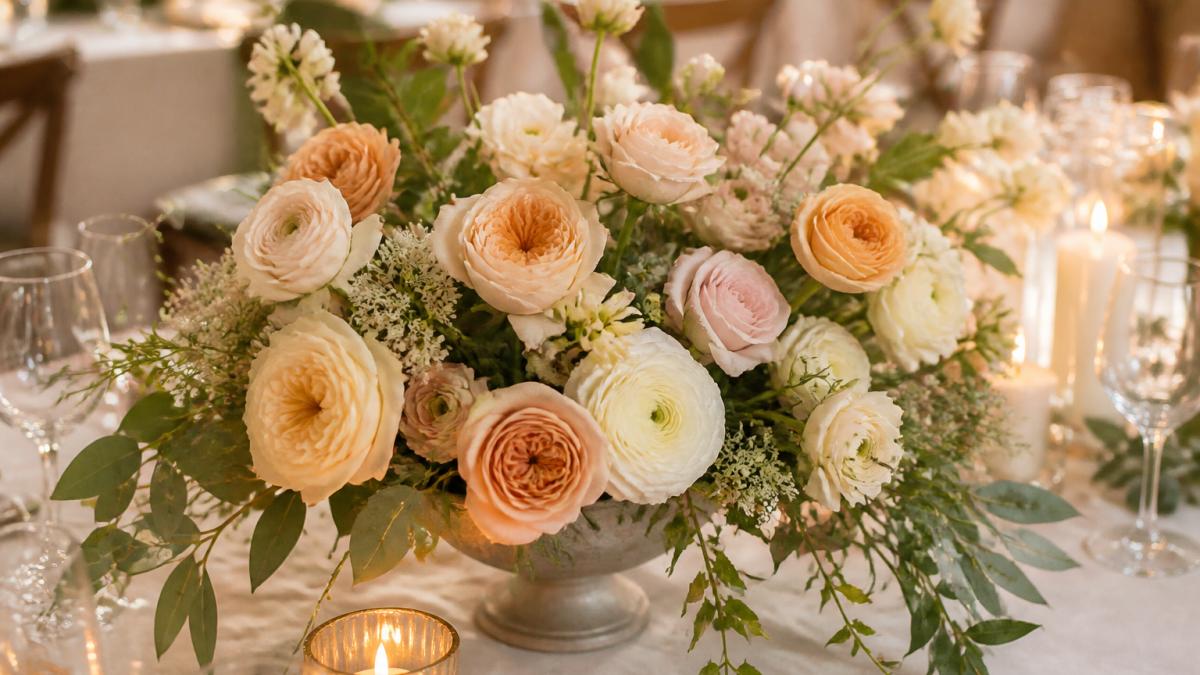
Your flowers should work across the entire venue, from ceremony arrangements to the bridal bouquet. Choosing centerpiece flowers early ensures consistency, simplifies ordering, and gives your florist time to source premium stems.
Sculptural and Statement Blooms
Sculptural flowers command attention without overwhelming a table, with architectural shapes that create interest even in minimalist arrangements. Proteas, anthuriums, and orchids lead this year because they hold their form and photograph beautifully.
Ranunculus remains a favorite for its layered petals, which create depth and movement. Poppies and cosmos add an unexpected edge for modern or garden-inspired aesthetics. Use these as focal flowers, paired with softer supporting blooms.
Romantic and Garden-Inspired Choices
Garden roses, sweet peas, and dahlias create the romantic, gathered-from-the-garden feeling many couples prefer. Garden roses offer rich color options and full, luxurious blooms that make even simple arrangements feel special.
Combine garden roses with clematis, astilbe, or soft greenery like eucalyptus for natural movement and texture. This works especially well for low centerpieces where guests need to see across the table.
Unexpected and Unconventional Botanicals
Couples are embracing unconventional choices that set their weddings apart. Amaranthus adds dramatic draping, stock provides architectural vertical lines, and chamomile, daisies, and ornamental grasses bring an earthy quality.
Balance is key: pair one or two unconventional elements with familiar flowers so arrangements feel intentional rather than random. A few stems of amaranthus with garden roses and ranunculus creates interest without chaos, and unusual botanicals often cost less than premium roses.
Seasonal Wedding Flowers and Regional Availability
Seasonality is the single biggest lever on what your centerpieces look like and what they cost. A peony in October is an imported, premium-priced stem; a dahlia in October is domestic, abundant, and a fraction of the cost.
How flower availability really works
Three supply streams feed the U.S. wedding market:
- Domestic field-grown. Follows a natural season, peaks spring through early fall, and is the most affordable and freshest option when available.
- Domestic greenhouse-grown. Extends the season for crops like roses, tulips, and lilies. More consistent year-round, priced between field-grown and imported.
- Imported. Fills gaps, especially in winter and for out-of-season blooms. Adds freight, cold-chain, and sometimes tariff costs, and stems may be older by the time they reach your florist.
Month-by-month centerpiece guidance
Use this as a starting point, then confirm with your florist, since timing shifts with weather and region.
- January-February: Tulips, anemones, ranunculus, and forced branches lead. Evergreens, berries, and dried botanicals carry texture. Orchids and anthuriums are reliable greenhouse/import options.
- March-April: Tulips peak, ranunculus and anemones are strong, and early peonies and sweet peas begin. Daffodils and hyacinths add scent and value.
- May-June: The peak wedding window. Peonies, garden roses, sweet peas, and early dahlias are at their best and most affordable, the easiest months to design around seasonality.
If your date falls in the May-June or September-October windows, you can build a premium-looking centerpiece almost entirely from in-season domestic stems. If your date falls in winter, budget more per stem and lean on evergreens, dried elements, and greenhouse blooms for value.
Regional availability: why your zip code matters
Availability is also regional. Growers in milder climates supply field-grown blooms earlier and later than colder regions, and local growers deliver fresher stems with less transit time. Couples in strong flower-farming regions can often source a wider in-season palette at lower cost.
Ask your florist two questions early:
- Which of my chosen flowers can be sourced domestically and in season on my date?
- Which will need to be imported, and what does that do to price and stem quality?
Substitution logic: what to swap when a bloom isn’t available
Every trend flower has a comparable stand-in. Knowing the swaps in advance keeps your design intact when a stem is unavailable, over budget, or unsuitable for the venue.
- Peony → garden rose or ranunculus. Similar full, layered form; garden roses are more available year-round.
- Garden rose → standard rose or spray rose. Less ruffled, but reliable and often cheaper.
- Ranunculus → stock or lisianthus. Similar density and softness; lisianthus holds up well in heat.
Build a substitution list into your floral contract. If a specific bloom is unavailable on your date, your florist should have pre-approved swaps that preserve the design and the budget, not a last-minute surprise.
The practical takeaway
Choose your date first, then your flowers. Couples who pick blooms before confirming the date pay a premium for out-of-season stems and accept older, imported product. Letting the season lead gets you fresher flowers, more design flexibility, and a lower per-centerpiece cost.
Color Palettes and Modern Floral Design Trends
2026 centerpiece trends favor bold monochromatic palettes or carefully curated multi-color combinations.
For bolder statements, jewel tones like emerald, sapphire, and burgundy are trending, working especially well in evening receptions or venues with dramatic lighting.
The modern approach emphasizes movement and varying heights. Rather than uniform, symmetrical arrangements, 2026 centerpieces feature stems at different lengths for a natural, slightly asymmetrical look that feels like a curated garden moment.
Low Wedding Centerpieces: Design and Flower Selection
Low centerpieces, typically 12 inches or shorter, remain essential because they let guests see and converse across the table. The best flowers for low wedding centerpieces have full, rounded forms like garden roses, ranunculus, and dahlias, visual impact without height.
Focus on density and texture rather than vertical drama.
Pair low centerpieces with bud vases as accents: small arrangements between larger ones add detail without blocking sightlines and let you incorporate more varieties.
Wedding Centerpiece Flower Cost and Budget Planning
Most centerpiece budget advice stops at “it depends.” Here is the practical framework florists actually use to price centerpieces.
What actually drives the price of a centerpiece
Four variables account for nearly all centerpiece cost variation:
- Focal flower choice. A garden rose, peony, or orchid stem costs several times what a stem of stock, carnation, or chrysanthemum costs. Two or three focal blooms per arrangement is typical; more and the price climbs quickly.
- Stem count and arrangement size. A low centerpiece in a 6-inch vessel might use 15-25 stems; a lush 10-inch design can use 40-60. Stem count, not vase size, is the real cost driver.
- Design complexity. Hand-tied, foam-free, cascading, or asymmetrical designs take more labor than a simple rounded arrangement. Labor is often 40-60% of a centerpiece’s price.
- Season and sourcing. In-season, domestic stems are consistently cheaper than out-of-season imports. A peony in May and a peony in December are not the same purchase.
Realistic per-centerpiece tiers
Use these as planning ranges, not quotes, pricing varies by market, venue access, and delivery:
- Bud vases and accents, roughly $15-$40 each. A few stems in a small vessel. Best used in clusters of three to five between larger designs.
- Standard low centerpiece, roughly $75-$150 each. A rounded, garden-style arrangement in a 6-8 inch vessel, 20-30 stems, mixed focal and filler.
- Premium low centerpiece, roughly $150-$300 each. Larger vessel, 35-50 stems, premium focals like garden roses or peonies, more texture and trailing elements.
Ask your florist for a per-centerpiece price at three stem counts (for example, 20, 30, and 40 stems) for the same design. Seeing the marginal cost of each additional tier is the fastest way to right-size your order.
The table-count math most couples skip
Centerpiece budget is a multiplication problem. A 150-guest wedding with 15 round tables needs 15 centerpieces. At $125 each, that’s $1,875 before tax, delivery, and setup; at $250 each, it’s $3,750, same guest count, double the floral line item.
Three levers reduce that total without gutting the look:
- Mix tiers across tables. Put premium designs on the head table and guest-of-honor tables, standard designs on the rest. Guests rarely compare tables side by side.
- Alternate centerpieces with bud-vase clusters. Every other table gets a full arrangement; the rest get three to five bud vases. The room still reads as floral, and the per-table cost drops sharply.
- Reduce table count, not quality. Longer tables or a mix of rounds and longs can cut the number of arrangements while keeping the same guest capacity.
Where the hidden costs live
Watch for line items outside the per-centerpiece price:
- Delivery and setup. Venue distance, load-in time, and whether your florist must return for breakdown all affect this. It’s frequently a flat fee plus a percentage of the floral total.
- Vessel rental. Many florists rent vases and stands rather than sell them; rental is usually cheaper but must be returned.
- Strike and cleanup. Removing arrangements after the event is sometimes a separate charge.
A simple budgeting sequence
- Set your total floral budget and reserve 10-15% for delivery, setup, tax, and contingency.
- Decide your table count and layout.
- Choose a per-centerpiece tier that fits the remaining budget.
- Pick focal flowers that are in season for your date (see the seasonal section).
- Ask for a written quote broken out by arrangement type, quantity, and fees, not a single lump sum.
That last step matters. A quote you can read line by line is a quote you can adjust line by line.
Affordable Wedding Centerpiece Flowers and Alternatives
If your budget is tight, several flowers offer excellent value.
Greenery-forward arrangements cut costs while remaining striking. Use eucalyptus, ruscus, salal, and other foliage as the foundation, then add a few premium focal flowers for sophisticated centerpieces at a fraction of the cost.
Seasonal flowers are always more affordable than out-of-season alternatives: a spring wedding with abundant tulips and peonies costs less than requesting those same flowers in December.
Flower Longevity, Care, and Sustainable Sourcing
Knowing how long centerpiece flowers last helps you plan timing. Garden roses typically last 7-10 days with proper care, ranunculus and dahlias similar, and orchids and proteas often stay fresh two weeks or longer.
Proper care extends flower life significantly: keep arrangements cool, change water every two days, and remove lower leaves that sit in water to prevent bacterial growth. Florists condition flowers with preservative and should deliver centerpieces as late as possible, ideally just before guests arrive.
Sustainable sourcing matters to many couples: locally grown flowers reduce transportation emissions and support regional growers, while seasonal selections minimize hothouse production. Locally grown flowers reduce transportation emissions and support regional growers, while seasonal selections minimize hothouse production.
Creating Your Centerpiece Selection Framework
Start by defining your style: romantic and garden-inspired, modern and minimalist, bold and dramatic, or naturally gathered and eclectic. This clarity guides every decision about flower selection, color palette, and design.
Next, identify your constraints: wedding date, venue style, budget, and table count. These determine which flowers are available, what they’ll cost, and how many arrangements you need, so discuss them with your florist early.
Then select 2-3 focal flower types to anchor each arrangement, add supporting flowers that complement them in color, texture, and form, and finish with greenery and filler for movement and volume. This structured approach ensures cohesive centerpieces throughout your reception.
Frequently Asked Questions
What are the best flowers for wedding centerpieces in 2026?
The top choices for 2026 include garden roses, ranunculus, calla lilies, orchids, and sculptural blooms like protea and anthuriums. Trending styles favor mixed-variety designs that combine soft blooms with statement flowers, natural textures, and varying heights. Your choice depends on your color palette, season, budget, and the overall aesthetic you want, romantic, modern, garden-inspired, or bold and unexpected.
Which flowers are most affordable for wedding centerpieces?
Affordable options include sunflowers, daisies, stock, tulips, and chamomile. Greenery and filler flowers like amaranthus also stretch your budget while adding movement and texture. Mixing one or two statement blooms with budget-friendly fillers creates impact without overspending. Pricing depends on quantity, dates, and delivery, contact An English Garden for a quote tailored to your needs.
How much do wedding flower centerpieces typically cost?
Centerpiece costs vary based on flower type, arrangement size, quantity needed, season, and delivery. Premium blooms like garden roses and orchids cost more than sunflowers or daisies. Seasonal flowers are generally less expensive than out-of-season imports. For accurate pricing based on your specific vision, table count, and wedding date, reach out to An English Garden for a personalized quote.
What flowers work best for low wedding centerpieces?
Low centerpieces suit ranunculus, garden roses, dahlias, calla lilies, and mixed blooms with draping or cascading stems. Keep arrangements under 12 inches tall to maintain sightlines across tables. Combine varying heights of flowers with moss, bud vases, and natural textures to create visual interest without height. This style works well for intimate gatherings and modern, minimalist aesthetics.
Can you mix fresh and dried flowers in wedding centerpieces?
Yes. Combining fresh and dried flowers adds texture, movement, and longevity to centerpieces. Dried amaranthus, pampas grass, and preserved greenery pair beautifully with fresh roses, ranunculus, and orchids. This mix works especially well for garden-inspired and modern designs. Dried elements also reduce overall floral costs and allow arrangements to last longer, which is practical for multi-day events or if you want to preserve centerpieces after the wedding.
How far in advance should I choose my wedding centerpiece flowers?
Choose flowers 2-3 months before your wedding to allow time for seasonal planning, cost estimation, and design consultations. For peak seasons (spring and summer), book earlier, 4-6 months ahead, to secure preferred blooms. Confirm final quantities and color details 2-3 weeks before the wedding. An English Garden’s experienced team can guide you through the timeline and help you make substitutions if needed.
What are the best seasonal flowers for wedding centerpieces?
Spring (March-May) offers tulips, ranunculus, peonies, and sweet peas. Summer (June-August) features garden roses, orchids, sunflowers, and cosmos. Fall (September-November) brings dahlias, protea, and amaranthus. Winter (December-February) offers roses, calla lilies, and imported blooms. Seasonal flowers are fresher, more affordable, and more sustainable. Discuss your wedding date with your florist to select the best in-season options for your centerpieces.
Should I choose local and sustainable flowers for my wedding centerpieces?
Locally sourced and sustainable flowers reduce environmental impact, support regional growers, and often cost less than imported blooms. They’re typically fresher and last longer. Many beautiful 2026 trends, garden-inspired, natural textures, and mixed botanicals, align perfectly with local sourcing. Ask your florist about regional availability for your wedding date. An English Garden can recommend sustainable options that fit your vision and budget.
When you’re ready to transform your centerpiece vision into reality, An English Garden offers expert design consultation and custom floral arrangements for your wedding. We handle delivery and on-site setup, ensuring your centerpieces are perfectly positioned and fresh when your guests arrive. Contact us to discuss your wedding flower needs and discover how we can create beautiful, memorable centerpieces for your celebration.
